
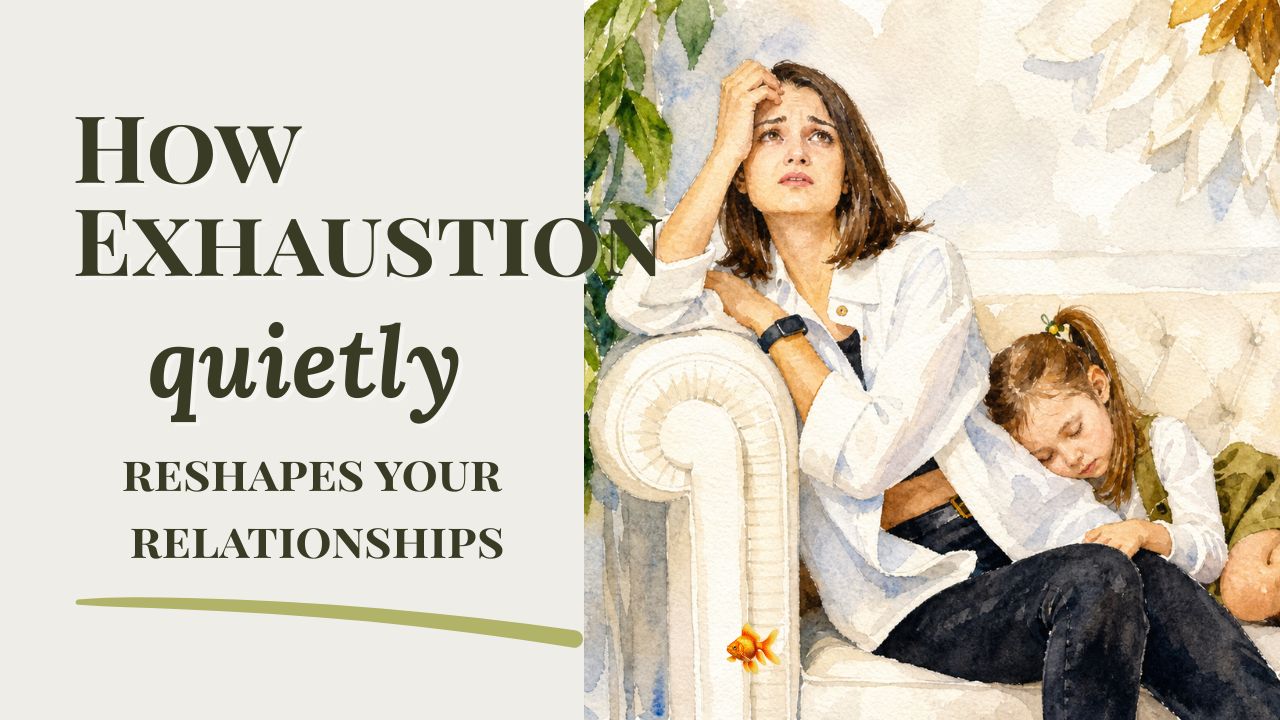
How exhaustion quietly reshapes your relationships
and what it looks like when things begin to shift.
Nobody warns you that burnout is contagious.
Not in the way a cold is. But in the quieter, slower way that matters more. The way your tension fills a room before you’ve said a word. The way your children learn to read your exhaustion and tiptoe around it. The way your partner stops bringing things to you because they can see you’re already at capacity.
You didn’t choose this. But if you’re honest with yourself, you’ve felt it happening. You’ve hoped nobody else noticed.
They noticed.
That’s not said to hurt you. It’s said because the women I work with almost always tell me the same thing once they start to heal: “I didn’t realize how much my energy was affecting everyone around me until it started to change.”
The Body That’s Here But the Mind That Isn’t
There’s a particular kind of exhaustion that doesn’t look like exhaustion from the outside. You’re still making lunches. Still answering emails. Still showing up. But inside, it feels like you’re watching yourself from slightly above, going through the motions of your own life while the real you has quietly checked out.
It can feel like a quiet disconnect from your own life. Not dramatic. Not noticeable to a doctor. Just… a persistent fog. A sense of going through the motions. A life that looks fine in the photos but feels hollow in the living of it.
And here’s the part nobody says out loud: the people closest to you can feel that hollowness. Children are often deeply sensitive to the emotional state of the adults around them. They don’t have words for it. They just get a little quieter, a little clingier, a little more anxious in ways you can’t quite trace back to anything specific.
“It’s not that I was mean or checked out on purpose. I was right there. I just… wasn’t.”
Burnout as a Relational Pattern, Not Just a Personal Problem
We talk about burnout like it’s something that happens to a person. But it’s more accurate to say it happens through relationships, and it shapes them deeply.
When you’re running on empty, your nervous system is in a near-constant state of low-grade stress. Your window of tolerance shrinks meaning the range of things you can respond to with warmth and patience gets narrower and narrower. Small things feel big. Requests feel like demands. Affection, when you’re depleted, can actually feel like just another thing being asked of you.
And so, without meaning to, you start to withdraw. Not dramatically. Just… a little less warmth here, a little less laughter there. You stop initiating. You stop sharing what’s really going on. The conversations stay on the surface because going deeper would take more than you have.
Over time, the people around you adapt to the version of you that’s available. Your partner learns which topics to avoid. Your kids stop asking for things they sense you can’t give. Your friendships quietly downgrade to check-in texts and “we should really get together soon” messages that never become actual plans.
These shifts rarely happen consciously. And all of it can change.
What Ancient Wisdom Understands About Dissolution
There’s a concept in Chinese philosophy I keep returning to for women in this particular kind of pain. Hexagram 59, called Huàn, or Dispersion, describes the natural process of things scattering before they can reorganize into something more whole. The image is wind moving over water: it doesn’t fight what’s there. It disperses it. Gently. Persistently. And what seemed stuck begins to move.
The wisdom here isn’t about forcing yourself back together. It’s about trusting that the falling apart is part of the process. What burnout scatters: your energy, your patience, your sense of self, was already under strain. The dispersion is information. It’s pointing to something that needed to change.
In practice, this means the path forward isn’t “try harder.” It’s closer to “get curious.” What is the exhaustion telling you? What patterns have you outgrown? What version of your life were you living for other people that your body is now refusing to maintain?
The Quiet Signs That Something Is Shifting
Women who are beginning to recover from this kind of burnout often describe the early signs not as dramatic breakthroughs, but as small, sensory moments of return. A genuine laugh that caught them off guard. A morning where they woke up and, for a few seconds, didn’t feel dread. A conversation with their child where they were actually there. Not performing presence, but feeling it.
These moments are not accidents. They’re evidence that the nervous system is starting to regulate again. That the body is beginning to trust that it’s safe to soften.
Burnout rarely lives only in the mind, which is why recovery often begins below the level of thought. You can talk yourself blue in the face about the need to slow down. The body tends to need a different kind of persuasion. For some women, practices like acupuncture can help.
Returning to Yourself, and to the People Who Love You
The women who come through my office carrying this particular kind of exhaustion are rarely looking for someone to tell them what to do. They already know something has to change. What they need is a space where they can stop performing okayness long enough to figure out what they actually feel, and then someone to walk beside them as they find their way back.
Back to themselves. Back to their relationships. Back to the version of their life that feels like it was actually built for them, not assembled out of other people’s expectations.
That process looks different for everyone. Sometimes healing begins with noticing you haven’t laughed in months. Sometimes it begins with realizing your family has been surviving alongside you instead of with you. And sometimes it begins with one honest admission: this version of life is no longer sustainable.
If any of this landed somewhere tender, that’s worth paying attention to. I’ve put together a short self-assessment to help you get a clearer picture of where burnout might be showing up in your body, your relationships, and your daily life — because naming it is often the first real step.