
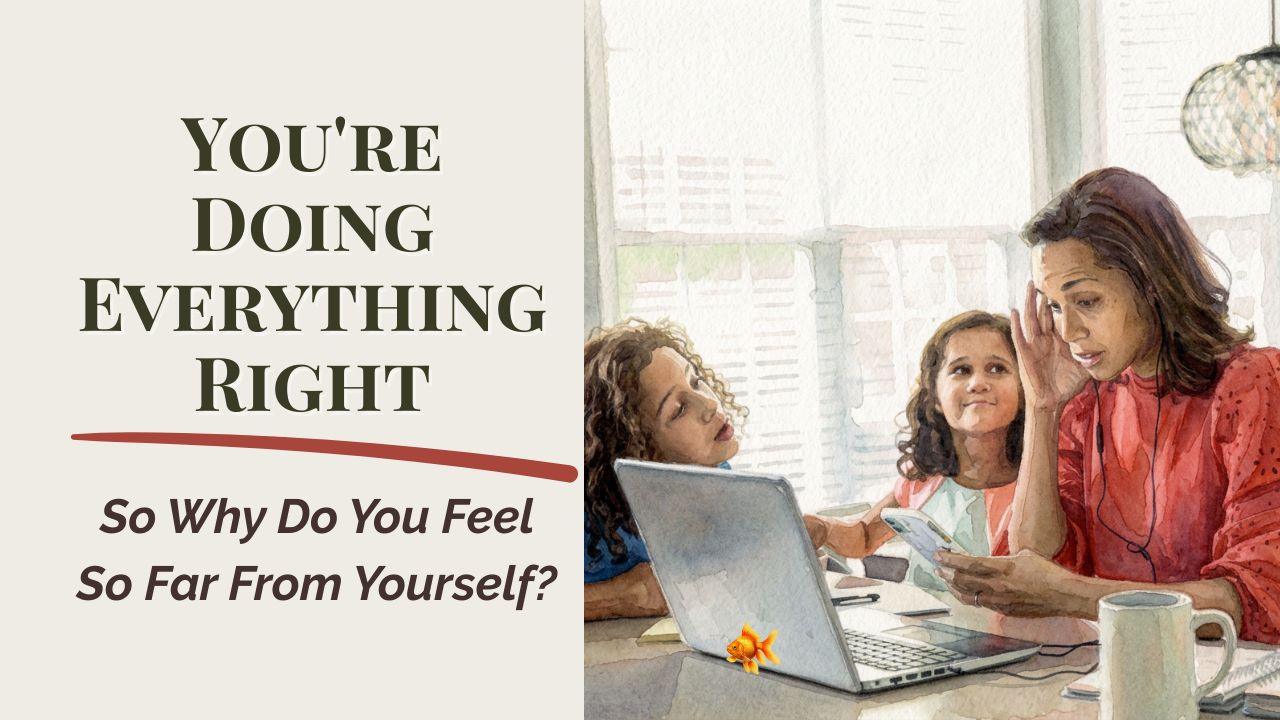
You navigate the office, nurture families, and manage the invisible load with unwavering dedication.
You answer the email before coffee. You schedule the dentist during lunch. You stay late because someone has to. And somewhere underneath all of it, you are running a persistent, low-grade tab of everything that still needs doing.
You are capable and genuinely good at all of it.
And you are so, so tired.
Not the kind of tired that sleep fixes. The kind that makes you wonder, quietly, when you stopped knowing what you actually want versus what you have learned to efficiently deliver.
That question is not a character flaw. It might be the most honest thing you have thought all week.
The Invisible Load Is Very, Very Real: Women and the Burnout Crisis
Let’s put some shape around what you might already know in your bones.
Women report burnout at significantly higher rates than men, with 59% of women experiencing burnout compared to 46% of men. Among millennials, 66% report significant burnout, compared to 39% of baby boomers. And women in the workforce are 8 percentage points more likely than men to report feeling like they are struggling or in crisis.
This is not a gender that needs to toughen up. This is a gender running a structural deficit between what is being asked and what is sustainably possible.
That Flatline Feeling: What Burnout Actually Does to Your Body
Burnout is technically described as exhaustion from long-term stress. But what it actually feels like is scrolling your phone at 10pm because your brain does not know how to stop. Snapping at your partner over something small and then crying, not entirely sure why. Going through all the right motions and feeling, somewhere underneath, like you are slightly behind yourself.
What is happening physiologically is that your body has been running its stress response for so long that it has forgotten it has another mode. Chronic stress keeps cortisol elevated, which over time disrupts sleep, mood, digestion, and hormonal balance. The system wired for rest and repair gets edged out. Relaxing starts to feel impossible and being productive starts to feel compulsive.
That is not a personal failing. That is a nervous system asking for help.
The Performance of Wellness and the Ache Underneath It
Women today are the most wellness-engaged group in history, and many still feel like something is missing. You are tracking your sleep. You are downloading the meditation app and forgetting to open it for three weeks. When we look at women by generation, 60% of millennials say they would take a 20% pay cut for a life that prioritizes wellbeing, and yet wellbeing still feels just out of reach.
The issue is not that the wellness culture is wrong. It is that it often addresses the surface without touching the root. What many women are actually hungry for is not more optimization. It is permission to stop optimizing for a moment and feel what is underneath.
That kind of work happens in the body first.
What Classical Acupuncture Understands That Hustle Culture Does Not
Classical acupuncture sees the body as a living system with intelligence. What we call burnout often maps onto patterns Classical Acupuncture has recognized for thousands of years. Energy that should be moving freely gets stuck and frustrated, deep reserves are depleted by sustained demand, and the heart and mind run too hot for too long without restoration.
These patterns open a different kind of conversation, one about the relationship between how you have been living and how your body is responding.
From a research perspective, acupuncture activates the parasympathetic nervous system, the branch responsible for rest and recovery, and has been shown to lower cortisol levels in people carrying chronic stress. A systematic review found it significantly reduced burnout symptoms, including anxiety and emotional exhaustion, by modulating the autonomic nervous system. In simpler terms: it helps your body remember how to shift out of emergency mode.
What It Feels Like to Lie Still for an Hour
One of the most underestimated parts of acupuncture is simply this: you are asked to do nothing for an hour.
No phone. No task list. No performing. You lie on a warm table and rest. For many women, it is the first genuine stillness they have accessed in months. And sometimes something surfaces in that stillness. Tears. A long exhale. A sense of your own body that you had not felt in a while.
You are also asked questions you may not have been asked in a long time. How are you sleeping. How do you feel in your body. Whether you feel hopeful or depleted. Someone paying attention to you as a whole person rather than a set of problems to resolve efficiently is, quietly, part of the medicine.
A Gentle Invitation Back to Yourself
Authenticity is not something you think your way into. You get quiet enough to hear what was always underneath the scheduling, the should, and the relentless forward motion.
Acupuncture creates conditions for that quiet. Gradually, over a series of treatments, many women notice something shifting. The reactivity softens. Sleep deepens. And in that slightly more spacious internal landscape, something starts to clarify. What actually matters. Who you are when you are not in survival mode.
That is where I come in. My practice works at the intersection of classical acupuncture and holistic women’s wellness. A first session is simply a conversation. I listen, I ask questions, and together we begin to map what support could look like for you.
The goal is not to help you perform wellness more efficiently. It is to help you come home to yourself.
Reach out whenever you are ready. There is no wrong time to begin.
Curious about how acupuncture supports stress, burnout, and women’s mental health? Schedule a free 15-minute consultation.